Non-Attorney Divorce Mediation in Bakersfield
Kern Mediation
A neutral, practical mediation service for people who want to work through divorce and separation issues respectfully, privately, and without turning every disagreement into a court fight.
1412 17th Street, Suite 310K, Bakersfield, CA 93301

Important Disclosure
Kern Mediation is a non-attorney divorce mediation service. Kern Mediation does not act as a lawyer for either party, does not provide legal advice, does not represent either party in court, does not predict how a judge will rule, and does not decide what either party should accept. The mediator’s role is to help both parties communicate, identify issues, organize agreements, and type a written Marital Settlement Agreement based on decisions made by the parties themselves.
Neutral Process
The mediator does not take sides. Both parties are given an opportunity to speak, ask questions, review terms, and decide whether an agreement works for them.
Party-Controlled Agreement
The parties decide the terms. The mediator may organize and type the agreement, but the final decisions belong to the parties.
Written MSA Goal
The expected product of successful mediation is a written Marital Settlement Agreement that can be reviewed, signed, and submitted in connection with the divorce case.
What Kern Mediation Does
Kern Mediation helps separating or divorcing spouses work through the practical decisions that often appear in a California divorce, including property, debts, parenting schedules, child-related expenses, support discussions, vehicles, retirement accounts, bank accounts, household items, pets, tax issues, and future communication. The service is designed for people who want a structured conversation and a written agreement rather than a prolonged fight.
Mediation is not the same as court. The mediator does not issue orders, does not make findings, does not determine who is “right,” and does not force either party to settle. Instead, mediation creates a private setting where both parties can discuss options and decide whether they can reach a voluntary written agreement.

The Main Goal: A Marital Settlement Agreement
The primary end result of successful divorce mediation is the preparation of a Marital Settlement Agreement, often called an MSA. The MSA is the written document that describes what the parties agreed to. It may address property division, debt division, child custody and visitation terms, child support, spousal support, retirement accounts, vehicles, tax responsibilities, insurance, pets, and other family-law issues that need to be resolved.
The most important point is this: the agreement is determined by the parties, not by the mediator. Kern Mediation may type the agreement, organize the language, and help make the document clear, but the mediator does not choose the terms. The mediator does not tell either person what they should demand or what they should give up.
Parties are encouraged to have any proposed agreement reviewed by an independent attorney before signing. A mediator can help write down an agreement, but only an attorney can provide legal advice about whether the agreement protects a party’s legal rights.

Issues Commonly Discussed in Divorce Mediation
Property and Community Estate
Parties may discuss how to divide bank accounts, vehicles, furniture, tools, household goods, real estate interests, business interests, retirement accounts, reimbursements, and other assets. California Family Code section 2550 generally provides for equal division of the community estate unless the parties make a written agreement or another rule applies.
Debts and Liabilities
Parties may discuss credit cards, loans, taxes, medical bills, vehicle loans, mortgage obligations, and reimbursement claims. California Family Code section 2622 addresses division of debts incurred during marriage and, in certain cases, how excess community debt may be assigned.
Disclosures
Divorce agreements should be based on full and accurate disclosure. California Family Code sections 2103, 2104, and 2105 address preliminary and final declarations of disclosure, including assets, debts, income, and expenses.
Parenting Plans
If children are involved, mediation may help parents discuss legal custody, physical custody, parenting schedules, exchanges, holidays, vacations, school decisions, medical decisions, communication, travel, and future dispute-resolution methods. California Family Code section 3020 emphasizes the health, safety, and welfare of children as the court’s primary concern.
Child Support
Parents may discuss income, timeshare, health insurance, childcare, uninsured medical costs, and other child-related expenses. California’s statewide child support guideline is addressed in Family Code section 4050 and related statutes.
Spousal Support
Parties may discuss whether spousal support will be paid, the amount, duration, review dates, termination events, and jurisdiction. California Family Code section 4320 lists factors courts consider for spousal support, and section 4330 addresses support orders in dissolution and legal separation cases.
How the Mediation Process Works
- Initial contact: The parties contact Kern Mediation and discuss whether mediation may be appropriate for their situation.
- Disclosure and expectations: The mediator explains the neutral role, confidentiality limits, voluntary participation, fees, and the difference between mediation and legal advice.
- Issue list: The parties identify what must be resolved, such as property, debts, parenting, support, taxes, insurance, vehicles, and retirement accounts.
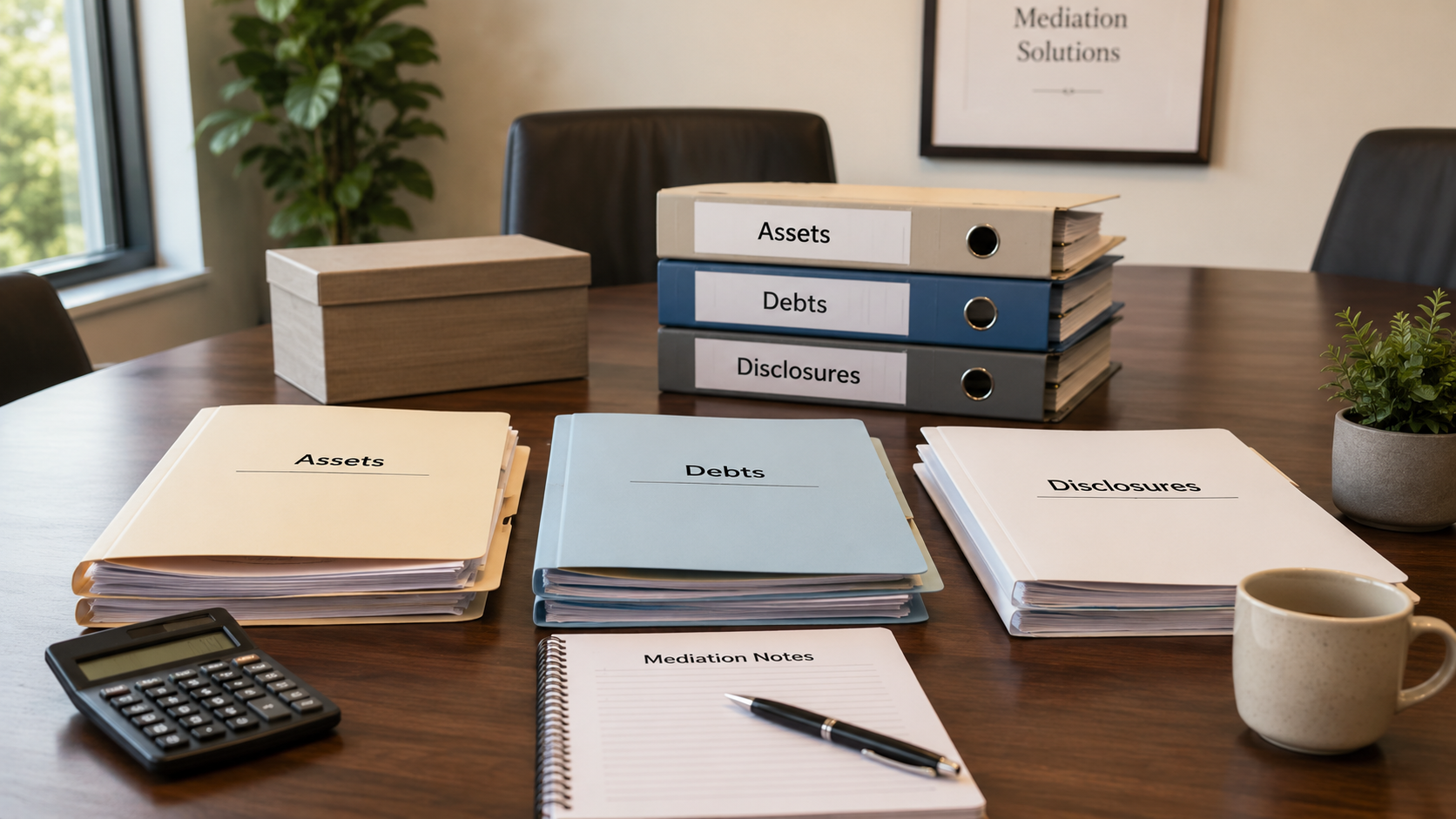
- Information exchange: The parties gather financial information, disclosure documents, account statements, asset values, debt balances, and other information needed for informed decisions.
- Mediation sessions: The mediator helps both parties discuss options and narrow disagreements without coercion.
- Drafting the agreement: If the parties reach agreement, the mediator types the Marital Settlement Agreement based on the parties’ decisions.
- Review before signing: Each party is encouraged to review the agreement carefully and seek independent legal advice before signing.
- Filing and court approval: The court, not the mediator, determines whether documents are accepted and whether orders or judgment are entered.
California Mediation Principles Referenced by Kern Mediation
California Rules of Court, rules 3.850 through 3.859, establish standards of conduct for mediators in court-connected mediation programs for general civil cases. Kern Mediation is a private non-attorney divorce mediation service and does not claim to be court-appointed or court-certified. However, these rules provide useful professional reference points for a mediation practice committed to neutrality, clarity, transparency, and party self-determination.
Selected Rule References
- Rule 3.850: Describes the purpose and function of mediator conduct standards in court-connected civil mediation programs.
- Rule 3.851: Explains when those rules apply to court-connected general civil mediation.
- Rule 3.852: Defines mediation as a process in which a neutral person facilitates communication to help parties reach a mutually acceptable agreement.
- Rule 3.853: Emphasizes voluntary participation and self-determination. A mediator should not coerce parties to settle.
- Rule 3.854: Addresses confidentiality and the mediator’s obligation to explain confidentiality at or before the first mediation session.
- Rule 3.855: Addresses impartiality, conflicts of interest, disclosures, and withdrawal when impartiality may be affected.
- Rule 3.856: Addresses competence and truthful representation of the mediator’s background, training, and experience.
- Rule 3.857: Addresses quality of the mediation process, procedural fairness, and the need to explain the roles of the mediator and participants.
- Rule 3.858: Addresses truthful marketing, no promises or guarantees of results, and avoiding statements implying favoritism.
- Rule 3.859: Addresses compensation, fee disclosures, no contingent mediation fees, and avoiding gifts or favors that could raise impartiality concerns.
Mediation Confidentiality and Written Agreements
California mediation confidentiality is an important subject. Evidence Code section 1115 defines mediation as a process where a neutral person facilitates communication between disputants to help them reach a mutually acceptable agreement. Evidence Code section 1119 generally protects mediation communications, negotiations, and writings prepared for mediation from disclosure and discovery, except as otherwise provided by law.
Evidence Code section 1121 generally limits mediator reports, assessments, evaluations, recommendations, or findings to the court, except as allowed by law or agreement. Evidence Code section 1122 addresses circumstances where mediation communications or writings may be disclosed by agreement. Evidence Code section 1123 addresses when a written settlement agreement prepared through mediation may be admissible or subject to disclosure, including where the signed agreement states that it is admissible, enforceable, binding, or subject to disclosure.
Because confidentiality rules can affect what can later be used in court, parties should ask questions before mediation begins and should consider speaking with an attorney if they are unsure about confidentiality, enforceability, or the legal effect of signing an agreement.
What Kern Mediation Does Not Do
- Kern Mediation does not provide legal advice.
- Kern Mediation does not represent either spouse.
- Kern Mediation does not appear in court for either party.
- Kern Mediation does not tell either party what legal position to take.
- Kern Mediation does not guarantee that the parties will settle.
- Kern Mediation does not guarantee that the court will approve any agreement.
- Kern Mediation does not hide assets, value assets, appraise property, provide tax advice, or provide financial planning.
- Kern Mediation does not replace independent legal counsel, tax professionals, real estate professionals, financial advisors, or mental-health professionals.
When Mediation May Be a Good Fit
Mediation may be a good fit when both parties are willing to participate in good faith, exchange financial information, discuss issues respectfully, and make decisions without pressure. It can be useful for couples who agree on most terms, couples who disagree on some issues but want to avoid escalating conflict, and parents who need a practical written parenting plan.
Mediation may be less appropriate when there is domestic violence, intimidation, hidden assets, severe power imbalance, substance abuse affecting decision-making, refusal to disclose financial information, urgent safety issues, or a need for immediate court orders. In those situations, parties should consider speaking with an attorney, contacting the court’s self-help center, or seeking appropriate safety resources.

Divorce Topics Often Included in an MSA
- Date of marriage and date of separation
- Confirmation of separate property
- Division of community property
- Division of debts and liabilities
- Vehicles and title transfers
- Bank accounts and credit cards
- Real estate, mortgages, sale terms, or buyout terms
- Retirement accounts and possible QDRO issues
- Household items and personal property
- Pets and pet-related agreements
- Tax filing status and tax refunds or liabilities
- Health insurance and life insurance
- Legal custody and physical custody
- Weekly parenting schedule
- Holiday and vacation schedules
- Transportation and exchanges
- Child support and add-on expenses
- Spousal support amount, duration, or waiver
- Future dispute resolution
- Signatures and enforceability language
California Divorce Reference Points
Kern Mediation may help parties discuss the practical issues that commonly arise under California divorce law, but the mediator does not interpret the law for either party or advise either party what outcome to choose. Common reference points include:
- Family Code section 2310: Grounds for dissolution or legal separation include irreconcilable differences or permanent legal incapacity to make decisions.
- Family Code section 2320: California divorce residency requirements generally require one party to have lived in California for six months and in the county for three months before filing for dissolution.
- Family Code section 2330: A dissolution or legal separation case begins by filing a petition or joint petition.
- Family Code section 2339: A divorce judgment generally is not final for terminating marital status until six months have passed from service of the summons and petition or the respondent’s appearance, whichever occurs first.
- Family Code section 2103, 2104, and 2105: Address financial disclosures, including preliminary and final declarations of disclosure.
- Family Code section 2550: Addresses equal division of community estate except by written agreement, oral stipulation, or other applicable law.
- Family Code section 2552: Addresses valuation timing for community assets and liabilities.
- Family Code section 2556: Addresses omitted or unadjudicated community assets or liabilities.
- Family Code section 2581: Addresses the presumption concerning property acquired during marriage in joint form.
- Family Code section 2622: Addresses division of certain debts and liabilities.
- Family Code section 3020 and 3040: Address child custody policy and best-interest considerations.
- Family Code section 4050 and related sections: Address California’s statewide uniform child support guideline.
- Family Code section 4320 and 4330: Address spousal support factors and support orders in dissolution or legal separation cases.

Why Choose Mediation?
Divorce litigation can be expensive, stressful, and slow. Mediation gives the parties a chance to focus on solutions, reduce conflict, and preserve control over the final agreement. Instead of asking a judge to decide every issue, the parties can work through the details themselves with the assistance of a neutral mediator.
Mediation can also be helpful for co-parents because it encourages direct problem-solving and future planning. A clear written agreement can reduce misunderstandings and provide structure for life after separation.
Schedule a Mediation Consultation
If you and the other party want to discuss divorce terms in a structured, neutral setting, contact Kern Mediation. The goal is to help both sides identify issues, discuss possible agreements, and prepare a written Marital Settlement Agreement based on the parties’ own decisions.
Kern Mediation
1412 17th Street, Suite 310K
Bakersfield, CA 93301
Non-Attorney Divorce Mediation Service